1 event found.
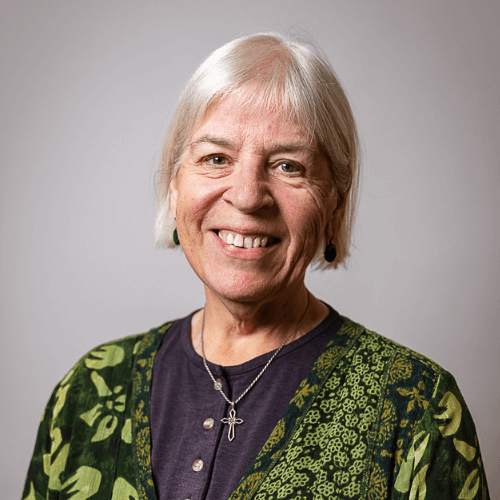
Dr. Deborah Bowen grew up in the south of England in a house full of books where both parents were professional writers.
After studying English Language and Literature at Oxford University, she taught first in high-school in Bristol and then at a teachers’ college in York before coming to Canada with her husband in 1977 to work with university students through Inter-Varsity Christian Fellowship.
Having gained a Ph.D. at the University of Ottawa, she taught there for several years and at the Université de Montréal for a year, before joining the faculty at Redeemer University in 1996.
She wants her students to understand how literature is an active force in the world and how their reading relates to the broader culture. She believes deeply that as they learn to interpret texts, they will also learn to read better both their own lives and those of other people.
Deborah has presented her research regularly at academic conferences, both specifically Christian and otherwise, and was from 2014-18 national co-chair of the Christianity and Literature Study Group, an affiliated organization with ACCUTE (the Association of Canadian College and University Teachers of English). She also served for eight years (2001-09) on the Senate of the Institute for Christian Studies in Toronto.
She has published two academic books, twelve chapters in academic collections, twenty-three papers in academic journals, and over forty academic book reviews. She has delivered eighty papers at conferences and about twenty plenary addresses.
She retired from full-time teaching in June 2017, but continues to teach part-time. Her present research involves the imaginative interface between poetry and ecology: for the first-fruits of this work, see https://www.redeemer.ca/wp-content/uploads/Poetry-and-Ecology-Project.pdf. Deborah is now working on a curated anthology of Ontarian poetry called Poetry in Place.
Deborah was delighted to learn about Global Scholars Canada, whose goals and vision are so closely attuned to those of her and her husband John. In fact, at her first big GSC meeting which she attended ‘virtually’ in June, she met up with a peer from Inter-Varsity during her Oxford days whom she hadn’t seen for more than forty years! She and John, who was until recently Professor of Evangelism at Wycliffe College, U of Toronto, have contacts with IVCF and IFES staff in a number of places in the world, and have always shared the vision of encouraging students to think Christianly about their academic disciplines, whatever those might be.
Deborah and John have two children, one a musician and one a writer, and four grandchildren, who look as if, in terms of gifts and abilities, they may well follow in the family footsteps.
Adrian and his wife, Wendy were GSC’s first scholars, they have served since 1995. Adrian has taught Philosophy or Theology on 11 campuses in 5 different countries including Russia, Nigeria, Tanzania, and The Gambia.
Adrian is also an author, and has written and presented many articles and lectures. He continues to fundraise for the Gambian Scholarship Program as both he and Wendy have transitioned to part-time service with GSC back home in Canada.
Support Adrian & Wendy Helleman


Adrian discussing Moscow Times article with political philosophy student at Moscow State University

Adrian teaching in St. Petersburg, Russia
2. NIGERIA – Jos & Ogbomosho – 2003 – 2008

Teaching in Jos, Nigeria

2012 – Adrian consulting with Cosmos, his graduate student.
3. TANZANIA – Mwanza – 2009

2009 – “This is a very special photo taken at the ‘tea-break’ … at a St. Augustine University of Tanzania seminar, focused on a Christian Worldview in dialogue with African and secular worldview approaches. … Here you see a very lively interaction with fellow faculty members during the break.”
4. THE GAMBIA – Kololi – 2012-2015

2015 – Adrian with a Gambian student & professor Layne Turner of the Christian Religious Studies program.

2019 – Adrian contributed “Seventy-Five Long Hours” and “A Nonviolent Revolution” in Dark Days of Authoritarianism: To Be in History. Edited by Melba Padilla Maggay. (London, UK: Langham Global Library).
“We taught in Bacolod, Philippines for six years… We also supervised a church and brought it to organization… I led Bible study groups with university staff, business men, and political prisoners. These Bible studies led to my involvement in the 1986 revolution that resulted in the expulsion of President Marcos.”
Adrian also authored Let Justice Flow Down Like a River: A Study Guide on Biblical Justice. Jos: Stream Publishers, 2004.
Adrian’s Global Scholar Profile
“Our involvement in what is now GSC began with my search for full-time work. After getting my PhD, I worked for a while as an interim pastor, but I needed to find an academic position. Thus, early in 1994, I pursued an ad in Christianity Today for a teaching position in Port Harcourt in Nigeria with an organization called IICS. The ad listed only a phone number and a postal box. But the 800-phone number was not accessible in Canada, so I wrote letters to both Christianity Today and IICS. At the time we had no idea what the acronym stood for, the International Institute for Christian Studies. It is the ancestor of Global Scholars (USA). …
Our next step was to raise the necessary funds. IICS is a faith mission. Fortunately, we still had a network of supporting churches and individuals. But to be able to issue tax receipts for donors, it was important to set up a Canadian charity that could receive funds on our behalf. … The new name for this charity was Christian Studies International, a name that was kept until its 20th anniversary (2015), following the recent selection of a new name for the American board: Global Scholars. The Canadian board then adopted its new name: Global Scholars Canada.
… We were first considered for placement in Lithuania or Romania. But then we learned that Dan Clendenin, who was serving at Moscow State University, was looking for someone to replace him. He wanted us to come to Moscow. We were still short of the funding needed for initial placement, but a generous donor in the US provided a grant sufficient for us to travel… That was how we arrived in Russia, where we spent seven wonderful years.”

2006 – Conference in Guatemala

2006 – Adrian with Global Scholars founder, Danny McCain, in Jos, Nigeria
“Two of Danny’s top students, Kiamu and Gwamna, defended their doctoral work with him. Adrian was internal examiner for both. Kiamu (at back) has established a theological school in Liberia; Gwamna (front right) lectured at the University of Jos for some time, but tragically, has since passed.”

2007 – Veenstra Seminary in Donga, Nigeria… “the sweetest welcome came from these children, belonging with families of staff and students on campus.” Adrian & Wendy gave seminars while Uni Jos was on strike.
Details from scholarly work in the field (2006-2012) – Academic Blog –Helleman News
“Since our return to Canada, I have served on several boards, including the Lighthouse, Citizens for Public Justice, and Logos, a student ministry at York University. I have also served on numerous committees. This is a pleasure we were unable to enjoy while we served outside Canada.”

Adrian & Wendy have 3 children, living in all parts of the world. Adrian’s hobbies include reading and tai chi.
Adrian earned 4 degrees from Calvin College – Bachelor of Arts (1966), Bachelor of Divinity (1969), Masters of Divinity (1977) and Masters of Theology (1988), and a Ph.D. of Philosophy in Theology at St. Michael’s College in 1992.
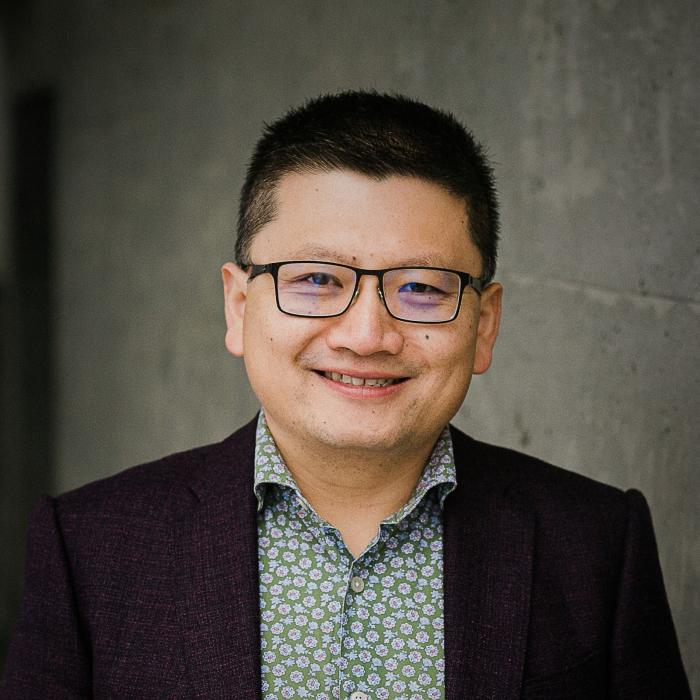
Dr. Gang Li was enthusiastically voted in by the GSC board on June 10th, 2023 after an earlier interview with a sub-committee of the board. He said, quoting Nietzsche, that he has a strong conviction about his why for joining the board. He now needs to settle into the how of his participation.
Dr. Li was an only child born and raised in the People’s Republic of China. There the social world was a clash of class interests which the government aimed to ameliorate through careful planning. Yet something seemed to be missing from this life.
An American teacher introduced the young Gang Li to the colourful and rich spiritual world of the Christian faith. Something came alive in him that he just could not let go, and over the next decade his own faith would grow.
He received his BA in English at Yantai University, China in 2002. Then he worked as an English teacher at Beijing New Oriental School for five years. From 2007 to 2008, Gang attended Cardiff University in the United Kingdom, completing an MSc in Education with distinction as a Chevening Scholar. There in Wales he attended a Presbyterian church. “That was one of the best years of my life,” recounts Li. “It was also a most wonderful experience of congregational life. The singing was just beautiful.”
Even today, Dr. Li experiences a deep sense of joy in Sunday worship. “Sometimes I feel so much joy in church,” he explains, “I just want to shout ‘Amen!’”
His next step in education was to do his PhD in education, and he applied to the program at UBC because of a certain church in the area that he thought would be nourishing for him. He knew no one in the region, but he took the leap to Canada. After much intense study and writing, and ten years of dissertation work, in 2020 he received his PhD in Educational Studies from UBC.
His PhD research was on the democratic sensibilities of Chinese international students who return home to China after being overseas. There are one million Chinese international students around the world and 70% are in English-speaking countries. How does their return affect China? What are their political and democratic sensibilities after spending years outside of China, and how does this influence the culture and future of China?
Dr. Li is not the typical education professor, as his expertise is not in teacher training. His fields of interest include leadership, governance, integration of faith and learning, and international higher education. He is particularly interested in reimagining leadership studies from the perspective of a Christian worldview particularly by reconceptualizing the notion and practices of leadership within the biblical metanarrative.
At the moment, Dr. Li is collaborating with other scholars in the China Innovative Urban-rural Governance Research Network to advance conceptual bases of community leadership in rural China through case study research.
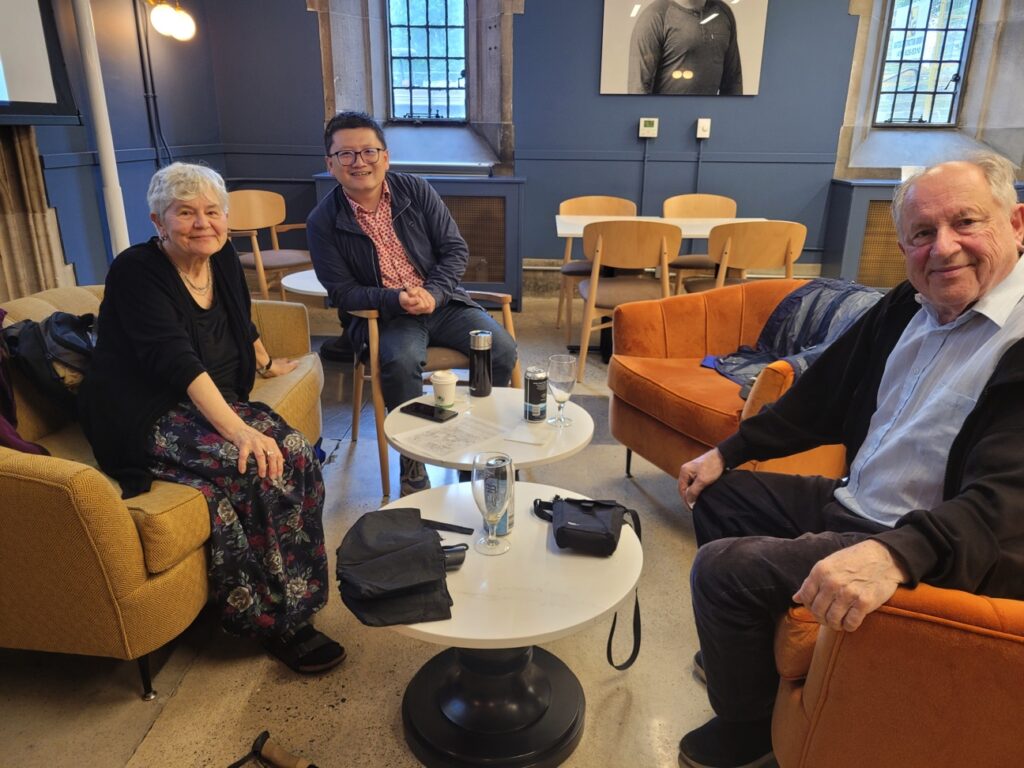
Gang travelled from BC to Ontario to attend GSC’s First Annual, ‘The Word & The World’ (Letters from Moscow) Symposium. He enjoyed a walking tour of the University of Toronto’s campus with Drs. Wendy & Adrian Helleman.
His next step in education was to do his PhD in education, and he applied to the program at UBC because of a certain church in the area that he thought would be nourishing for him. He knew no one in the region, but he took the leap to Canada. After much intense study and writing, and ten years of dissertation work, in 2020 he received his PhD in Educational Studies from UBC.
If asked about his core values, Dr. Li points to the virtues of goodness and humility. “The world is complex with multiple dimensions,” he explains, “and we need to honour the wisdom of God in diversifying church denominations. No single church is the only true church, and the instances of church violence of the past such as those against the Anabaptists were wrong.” Dr. Li is an ardent ecumenist, and pushes for public apologies where needed, and to the need for constant collaboration.
What is Dr. Li currently reading? He is always ready to speak of his love for the work of theologian John Owen (all 17 volumes!), and especially the way in which Owen makes faith not just a matter of dogmatic assertion but also heartfelt experience. “He is the Prince of Puritans,” explains Li, who is currently reading Volume 6 on indwelling sin in believers and the mortification of sin.
He is enjoying Conceiving the Christian College by Duane Litfin (2004), which asks how Christian universities keep their bearings in the tumultuous intellectual seas of the twenty-first century. The author writes of the importance of holding fast to one’s core identity in the midst of the cross-pressures of our age.
As mentioned above, Dr. Li teaches a lot in leadership and organizational management. He appreciates Brené Brown’s work Dare to Lead: Brave Work. Tough Conversations. Whole Hearts (Random House 2018). The writer insists that leadership is not about status or power but rather recognizing the potential in people and ideas, and having the courage to experiment with that potential. In other words, it is not about being the person with all the right answers, but being the most curious person in the room who asks the right questions. It is not about power as much as the courage to be vulnerable and take creative risks for the greater good.
Dr. Li can talk easily about grand ideas of leadership. But those ideas are contextualized by what is most important to him: knowing that he is beloved—by his parents, by his church, friends and colleagues–and all that as a means by which God, in Jesus Christ, by the Holy Spirit, calls him his own, body and soul, in life and death (to allude to the Heidelberg Catechism Q &A #1).